
The Shift to Zero-Trust in Cloud Environments
In modern cloud-native architectures, the traditional perimeter security model ("castle-and-moat") is no longer sufficient. Once an attacker breaches the perimeter or gains compromised credentials, flat networks allow unrestricted lateral movement.
As an AWS Certified Cloud Practitioner passionate about security engineering, I advocate for and design systems adhering to the Zero-Trust philosophy: never trust, always verify. Every request, regardless of where it originates, must be authenticated, authorized, and continuously validated against strict policy controls.
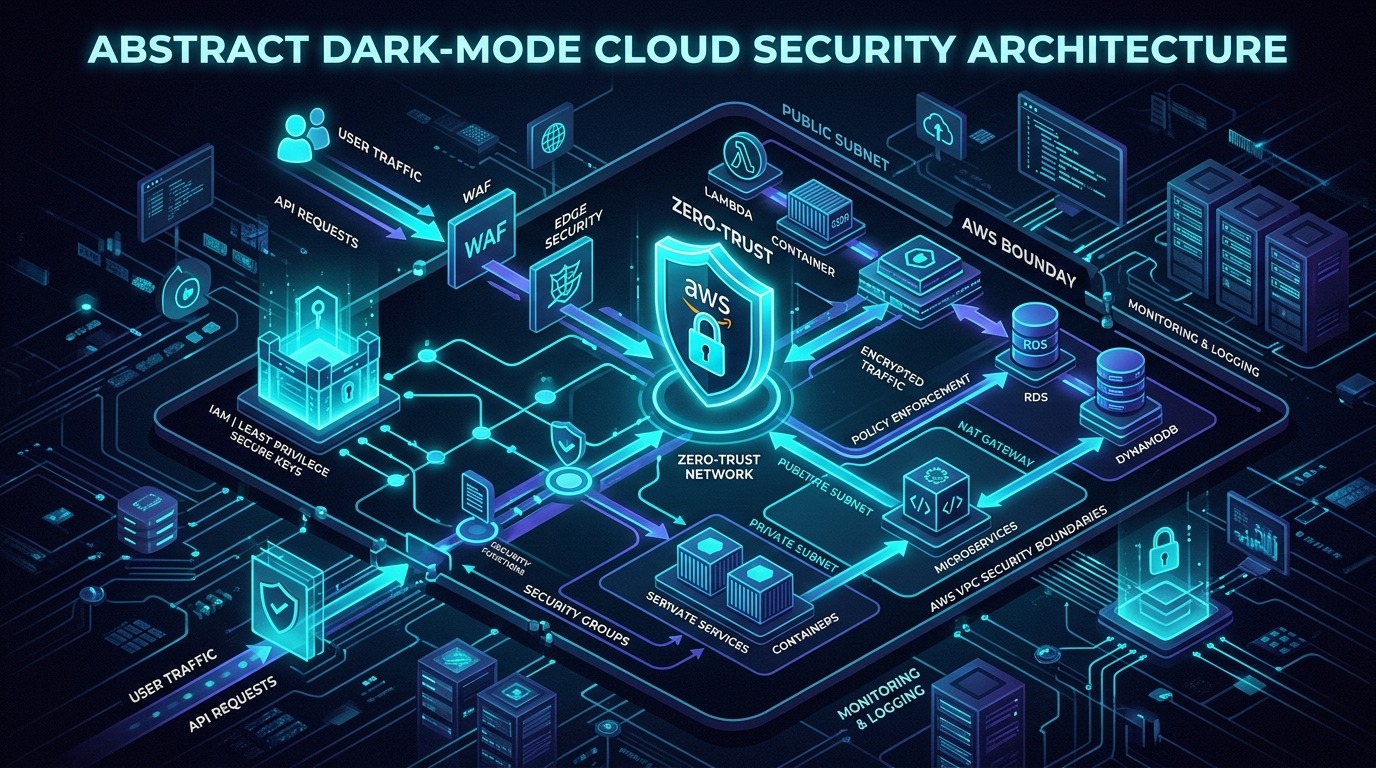
VPC Architecture & Network Segmentation
A resilient cloud infrastructure begins with strict network segmentation. By isolating tiers within an Amazon Virtual Private Cloud (VPC), attack surfaces are minimized:
1. Multi-Tier Subnet Layout
- Public Subnet: Restricted strictly to edge routing components—Application Load Balancers (ALB) and NAT Gateways. No application compute or database instances reside here.
- Private Subnet (Application Tier): Hosts microservices, containers (ECS/EKS), or serverless compute (AWS Lambda). Instances communicate outward to the internet only via NAT Gateways; no direct inbound connections from the public internet are permitted.
- Isolated Subnet (Data Tier): Hosts Amazon RDS, DynamoDB VPC endpoints, and sensitive caches. Completely cut off from internet routing tables; accessible only by explicit security group ingress from the application tier.
2. Microsegmentation with Security Groups & Network ACLs
- Stateful Security Groups: Enforce least privilege at the host level, only permitting HTTPS (port 443) or database traffic from explicitly referenced security group IDs.
- Stateless Network ACLs: Provide a secondary layer of subnet-level packet filtering against known malicious CIDR blocks.
IAM Hardening & The Principle of Least Privilege
Identity is the new perimeter in cloud security. A single over-privileged service account can compromise entire production environments.
1. Granular Policies over Wildcards
Never use wildcard actions ("Action": "*") in production policies. Each microservice must possess its own dedicated IAM role scoped specifically to the exact resources it touches:
{
  "Version": "2012-10-17",
  "Statement": [
    {
      "Sid": "RestrictedSESDispatch",
      "Effect": "Allow",
      "Action": [
        "ses:SendEmail",
        "ses:SendRawEmail"
      ],
      "Resource": "arn:aws:ses:us-east-1:123456789012:identity/adityark.dev"
    }
  ]
}
2. IAM Roles for Service Accounts & Workload Identity
Eliminate hardcoded API keys from codebases and container environment variables. Services running on AWS should assume IAM roles via STS temporary credentials, rotated automatically without human intervention.
Observability & Automated Threat Detection
Zero-trust requires real-time telemetry and auditing across every API interaction:
- AWS CloudTrail: Captures every management event and API mutation across all regions, streaming logs directly to an encrypted S3 bucket and CloudWatch Logs.
- VPC Flow Logs: Monitors IP traffic entering and exiting network interfaces, piped to Splunk SIEM for automated brute-force and port-scanning anomaly detection.
- AWS GuardDuty: Leverages machine learning over DNS logs, CloudTrail events, and VPC flow logs to identify unauthorized credential behavior or cryptomining patterns.
Conclusion
Engineering secure cloud systems is not a one-time checklist, but a continuous practice of reduction: reducing permissions, reducing network exposure, and reducing blast radiuses.
By combining well-architected AWS VPC boundaries with least-privilege IAM policies and SIEM telemetry, teams can build fast without compromising on enterprise security posture.